By Eli Butbul, Founder, GoldeNet Australia | Published 12 November 2026
Cut, colour, clarity and carat weight, known as the 4Cs, are the standard way to describe a diamond's quality. Knowing what each one means is useful; knowing how to balance them is what helps you choose a beautiful diamond for your budget. This guide explains the 4Cs in practical terms, why cut deserves close attention, and how a grading report helps you compare diamonds fairly.
Key takeaways
- Cut has a major influence on how a diamond looks, because it controls how the diamond returns light, but no single characteristic decides beauty on its own.
- A diamond that looks large for its weight is not necessarily well cut. Poor proportions can leak light or hide weight where you can't see it.
- Colour and clarity differences are often subtle. Choose grades that look right to you rather than paying for differences you can't see.
- Carat measures weight, not size, and prices can rise noticeably at popular weights.
- An independent grading report lets you check the 4Cs and compare diamonds like with like.
In this guide:
Cut: the C that shapes sparkle
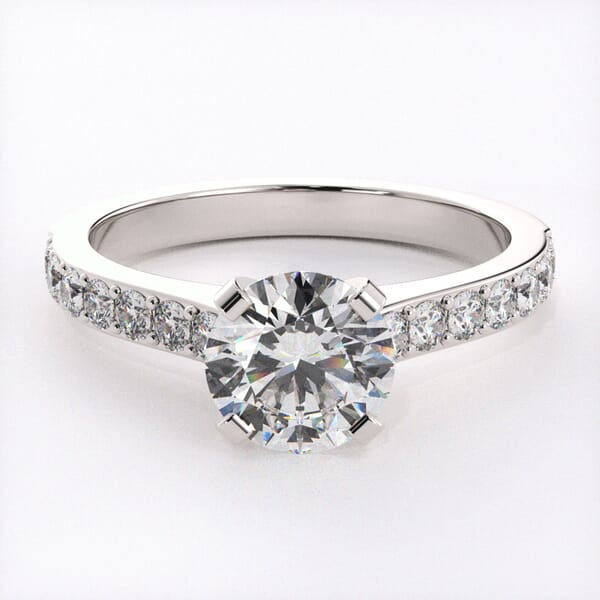
A diamond's cut refers to how it interacts with light, which depends on its proportions, symmetry and polish. A well-cut diamond returns light as brightness (white light reflected back to the eye), fire (flashes of spectral colour) and scintillation (the sparkle you see as the diamond or the light moves). That is why cut has such a strong influence on a diamond's beauty.
For standard round brilliant diamonds, GIA gives an overall cut grade on a five-point scale: Excellent, Very Good, Good, Fair or Poor. Other shapes, such as oval, pear and emerald cuts, are known as fancy shapes and don't receive an overall GIA cut grade, although GIA still grades their polish and symmetry. Other laboratories may use different systems to assess the cut of fancy shapes. Polish and symmetry describe the diamond's finish; on their own they don't establish overall cut quality, so for fancy shapes, looking at the diamond itself, or at good-quality images and video, is especially important. Learn more about diamond cut.
Bigger-looking doesn't mean better cut
It's natural to want a diamond that looks as large as possible, but face-up size alone doesn't tell you how well a diamond is cut. Every diamond's appearance depends on how its proportions work together:
- A pavilion (the lower part of the diamond) that is too shallow or too deep can let light leak out of the diamond, so less light returns through the top and it looks less bright. GIA notes that these proportions can also reduce face-up size.
- A thick girdle (the outer edge) can carry extra weight that adds to the cost without adding to the diamond's visible size.
- Proportions work together, so the combination matters more than any single measurement. That is why the overall cut grade for round diamonds, and a careful look at fancy shapes, are more useful than any single number on a report.
GIA gives a striking example: a poorly cut 1.20 carat diamond may appear to be the same size as a well-cut 1.00 carat diamond.
The aim is a diamond that is both well proportioned and bright, not simply the one with the largest diameter for its weight.
Colour
For white diamonds, colour grading measures how close a diamond is to colourless. GIA's scale runs from D, the top colourless grade, to Z, which shows a light yellow, brown or grey tint. Colour is graded in precise conditions under controlled lighting, because the differences between neighbouring grades are subtle.
Because the differences between neighbouring grades are subtle, they can be hard to see once a diamond is set and worn. The setting metal also affects how colour appears: GIA notes that a yellow gold band can bring out a hint of yellow in a diamond, while a white metal such as white gold or platinum can make it appear more colourless. The visual effect varies with the individual diamond, the setting design and the lighting. Read more about diamond colour.
Clarity
Clarity describes a diamond's internal characteristics (inclusions) and surface characteristics (blemishes). GIA's clarity scale has 11 grades in six categories: Flawless (FL), Internally Flawless (IF), Very, Very Slightly Included (VVS1 and VVS2), Very Slightly Included (VS1 and VS2), Slightly Included (SI1 and SI2) and Included (I1, I2 and I3). Diamonds are graded under 10x magnification.
Many inclusions are not visible to the naked eye, so a diamond with a lower clarity grade can look clean when worn. Whether a particular diamond looks clean depends on its individual inclusions, not on the grade alone, so check each diamond individually. Read more about diamond clarity.
Carat weight
A metric carat is 200 milligrams, and each carat is divided into 100 points, so a 0.75 carat diamond can also be described as 75 points. Carat measures weight, not size: two diamonds of the same weight can look different face-up depending on their shape and proportions.
Carat weight has a strong effect on price, but two diamonds of the same weight aren't necessarily equal, because cut, colour and clarity also affect value. GIA also notes that certain weights, such as one carat, are considered "magic sizes", and the price difference at those sizes can be significant. Read more about carat weight.
Balancing the 4Cs within your budget
No single grade makes a diamond beautiful. A practical way to choose is:
- Start with cut. For a round brilliant, look for a high cut grade. For a fancy shape, also consider its outline, length-to-width ratio, light performance and any visible inclusions, alongside polish and symmetry, and judge the diamond visually.
- Decide on size. Choose a carat weight range that suits the look you want and your budget. Consider a weight slightly below a popular size if it fits better.
- Choose colour for the setting. Think about the metal you plan to use and how white you want the diamond to appear.
- Choose clarity for appearance. Look for a diamond whose inclusions you can't see in normal wear, rather than the highest grade you can afford.
- Compare several options. Looking at diamonds together, in person or through good-quality images and video, is the clearest way to understand what each trade-off looks like.
GoldeNet can help you compare suitable diamond options within your budget.
Laboratory-grown diamonds are graded using the same characteristics, though report formats can differ. For similar specifications they usually cost considerably less than natural diamonds; our guide to lab-grown vs natural diamonds in Australia explains the differences. You can start comparing options among our certified diamonds and laboratory-grown diamonds.
Grading reports and certification
An independent grading report from a recognised laboratory records a diamond's measurements and grades, so you can check what you are buying and compare diamonds fairly. Many diamonds are also laser-inscribed with their report number, which helps match the diamond to its report.
When comparing reports, compare diamonds graded by the same laboratory where possible, because grading practices and report formats are not always identical. For example, since 1 October 2025 GIA has described eligible laboratory-grown diamonds as Premium or Standard rather than using its traditional colour and clarity grades. This is GIA's own system for eligible stones, not one used by every laboratory; IGI, for instance, continues to grade laboratory-grown diamonds using the traditional 4Cs. For more detail, see our diamond certificate guide and what to look for when buying a certified diamond in Australia.
Want a second opinion on a diamond?
Tell us your budget and the shape you like using the Get in Touch form below, and we can suggest diamonds that balance the 4Cs for you. You can also use the form to request a free, no-obligation consultation: a call back, or a time to meet with us at our Melbourne showroom. If you prefer to shop remotely, contact us online and we can help by phone or email.
Showroom visits are by appointment only.
Frequently asked questions
Which of the 4Cs is most important?
No single C is decisive on its own. Cut has a major influence on how bright and lively a diamond looks, especially for round brilliants, so it is a sensible place to start. For fancy shapes, outline, length-to-width ratio and visible inclusions matter too. After that, the right balance of carat, colour and clarity depends on your budget and the look you want.
What colour and clarity grade should I choose?
There's no single correct grade. Choose a colour that looks right in your chosen metal and a clarity grade with no inclusions you can see in normal wear. Comparing diamonds side by side is the best way to decide.
Does a bigger carat weight mean a bigger-looking diamond?
Not always. Carat is weight, not size, and proportions affect how large a diamond looks face-up. Some weight can sit in parts of the diamond you can't see once it's set.
Do fancy-shaped diamonds have a cut grade?
GIA gives an overall cut grade only to standard round brilliant diamonds. For fancy shapes such as ovals, a GIA report includes polish and symmetry, and other laboratories may assess cut differently. Either way, judge the diamond's appearance visually.
Related reading
About the author
Eli Butbul, Founder, GoldeNet Australia
Eli Butbul is the founder of GoldeNet Australia, with approximately 20 years of experience in the diamond and jewellery industry. Through GoldeNet, Eli has helped customers explore diamonds, compare engagement ring designs and make informed jewellery purchasing decisions.
His articles focus on practical diamond education, engagement ring selection, jewellery quality and value for Australian buyers.
 Free Shipping and Handling
 30 Day Money Back Guarantee
 Free Gift Packaging